10 Best Budget Bouldering Crash Pads (2026)
Looking for the best budget bouldering crash pad? A pad is the most important safety purchase an outdoor boulderer makes, and the right one does not have to be the most expensive. We compared manufacturer specs and public buyer feedback to pick 10 pads, from beginner-friendly budget models to big-landing options from Metolius, Asana, Petzl and others.
Key Takeaways
- Best value: Asana Hero for climbers who want a full-size dual-density pad without flagship pricing.
- Best for beginners: Metolius Session II, a proven classic that works for most outdoor boulders.
- Best big landing: Metolius Magnum or Petzl Cirro when the boulders get tall.
- Reality check: A crash pad reduces injury risk but does not make high falls safe. Spotters and a pad plan still matter.
Best Budget Bouldering Crash Pads at a Glance
| # | Product | Best For | Standout | Score | |
|---|---|---|---|---|---|
| 1 | Asana Hero Bouldering Crash Pad | Most climbers who want a full-size pad that is not a flagship price | Triple-layer dual-density foam | 9.2 | Check Price → |
| 2 | Asana Focus Crash Pad | Beginners and casual boulderers | Dual-density foam at a gentler price tier | 8.8 | Check Price → |
| 3 | Metolius Session II Crash Pad | First-time pad buyers | Classic Metolius design | 9.0 | Check Price → |
| 4 | Metolius Magnum Crash Pad | Tall problems and uneven landings | Large and well padded | 9.0 | Check Price → |
| 5 | Metolius Recon Pad | Climbers who want a smaller, easier-to-carry pad | Compact and lightweight | 8.7 | Check Price → |
| 6 | TRANGO Stratus Crash Pad | Climbers who like Trango gear | Climbing-brand construction | 8.6 | Check Price → |
| 7 | Petzl Cirro Crashpad | Climbers who want a large Petzl pad | Large coverage from a trusted gear brand | 8.9 | Check Price → |
| 8 | Petzl Nimbo Crashpad | Climbers who want a pad designed for smooth landings | Slider foam design | 8.7 | Check Price → |
| 9 | Ocun Moonwalk FTS Crash Pad | Climbers who want a European climbing-brand pad | Climbing-specific design | 8.4 | Check Price → |
| 10 | Meister Boulder Beast XL Tri-Fold | Bargain hunters and gym-to-crag beginners | Large tri-fold design with backpack straps | 8.2 | Check Price → |
The 10 Best Budget Bouldering Crash Pads, Reviewed

Asana Hero Bouldering Crash Pad
Best for: Most climbers who want a full-size pad that is not a flagship priceThe Asana Hero is a full-size bouldering pad with dual-density foam layers and a backpack-style carry system. It is the sort of pad that suits both gym-to-crag climbers and regular outdoor boulderers. Check the listing for the exact dimensions and weight of your size.
Pros
- Dual-density foam
- Backpack-style carry
- Good all-round size
Cons
- Not the lightest option
- Large pads are awkward on tight trails
Skip it if: you hike long distances and need an ultralight pad.
Check Price on Amazon →
Asana Focus Crash Pad
Best for: Beginners and casual boulderersThe Focus is a step down in price from the Hero but keeps the dual-density foam that makes a pad feel supportive. It is a simple pad for climbers who want a dependable landing without paying for extra features.
Pros
- Dual-density foam
- Simple design
- Easier on the budget
Cons
- Fewer comfort and carry features
- Smaller options may limit coverage
Skip it if: you boulder big highballs and need maximum coverage.
Check Price on Amazon →
Metolius Session II Crash Pad
Best for: First-time pad buyersThe Session II is one of the best-known beginner pads. It is a straightforward hinged pad with a proven design and a sensible size for most outdoor boulders. If you want something that works without fuss, this is it.
Pros
- Proven design
- Easy to carry
- Good beginner pad
Cons
- Less padding than larger pads
- Basic carry system
Skip it if: you want a large landing zone for tall problems.
Check Price on Amazon →
Metolius Magnum Crash Pad
Best for: Tall problems and uneven landingsThe Magnum is Metolius’ big pad. It gives more coverage and thicker foam than the entry pads, which helps on tall problems and uneven ground. The tradeoff is bulk and weight on the approach.
Pros
- Large landing area
- Thicker foam
- Good for highballs
Cons
- Heavier and bulkier
- Not ideal for long approaches
Skip it if: your boulders are short and the walk-in is long.
Check Price on Amazon →
Metolius Recon Pad
Best for: Climbers who want a smaller, easier-to-carry padThe Recon is a smaller Metolius pad aimed at climbers who value portability. It works as a primary pad for short problems or as a second pad stacked with a bigger one for extra coverage.
Pros
- Compact size
- Easier to carry
- Works as a second pad
Cons
- Less coverage on its own
- Not for tall problems
Skip it if: you boulder highballs and need as much landing area as possible.
Check Price on Amazon →
TRANGO Stratus Crash Pad
Best for: Climbers who like Trango gearThe Stratus is a Trango bouldering pad from a long-established climbing brand. Check the exact size and foam spec in the listing, as Trango offers more than one pad. It is a good choice if you want a climbing-specific brand.
Pros
- Climbing-brand design
- Good foam
- Backpack-style carry
Cons
- Fewer reviews than Metolius pads
- Check size before ordering
Skip it if: you already own a pad that works well.
Check Price on Amazon →
Petzl Cirro Crashpad
Best for: Climbers who want a large Petzl padThe Cirro is a Petzl crash pad made for outdoor bouldering. It offers large landing coverage and the quality control that Petzl is known for. It suits climbers who want a premium pad and will carry the weight.
Pros
- Large landing area
- Trusted brand
- Solid build quality
Cons
- Large and heavy
- Premium pricing
Skip it if: you hike long distances or want a lighter pad.
Check Price on Amazon →
Petzl Nimbo Crashpad
Best for: Climbers who want a pad designed for smooth landingsThe Nimbo is a Petzl pad with a slider-foam design aimed at smooth landings. It is made for outdoor bouldering and suits climbers who want a quality pad from a well-known brand.
Pros
- Slider foam design
- Trusted brand
- Good coverage
Cons
- Heavier than basic pads
- Price sits above entry pads
Skip it if: you want the cheapest option available.
Check Price on Amazon →
Ocun Moonwalk FTS Crash Pad
Best for: Climbers who want a European climbing-brand padThe Moonwalk FTS comes from Ocun, a climbing brand known for shoes and gear. It is a solid pad for outdoor bouldering. Check the listing for size and fold style, as Ocun offers several pads.
Pros
- Climbing-brand design
- Good outdoor build
- Decent carry system
Cons
- Less common in US shops
- Check size before ordering
Skip it if: you want a pad with a large US support network.
Check Price on Amazon →
Meister Boulder Beast XL Tri-Fold
Best for: Bargain hunters and gym-to-crag beginnersThe Meister Boulder Beast XL is a large tri-fold pad with backpack straps at a budget price. It gives you plenty of landing area for the money. As with any lesser-known brand, check the buyer feedback on durability before committing.
Pros
- Large landing area
- Backpack straps
- Budget price
Cons
- Lesser-known brand
- Durability reports vary
Skip it if: you boulder often on rough terrain and want proven durability.
Check Price on Amazon →How to Choose a Bouldering Crash Pad
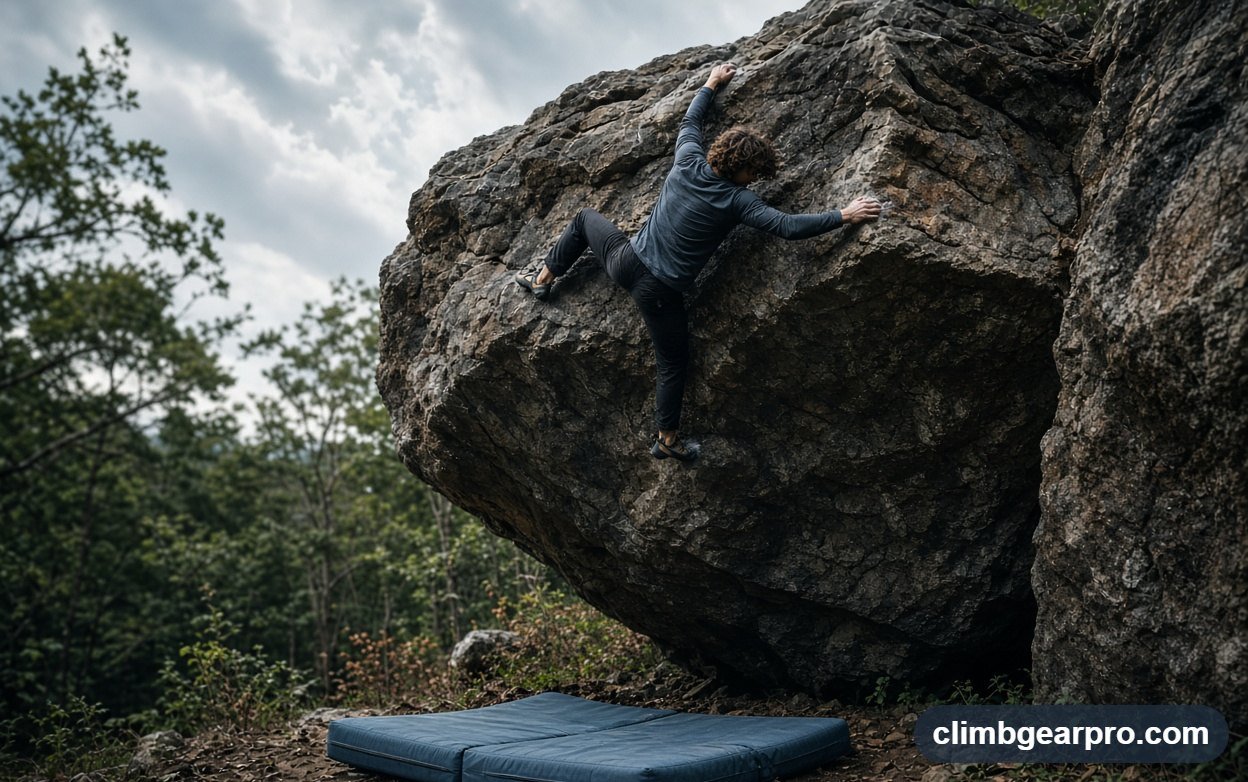
Start with the terrain. Flat, clean landings suit a single mid-size pad. Rocky, sloping or uneven landings need more coverage, and that usually means a bigger pad or a second one. Think about your approach too, because a huge pad that you cannot carry is a pad you will leave in the car.
Foam, Hinges and Carry Systems
Dual-density foam pairs a firmer top layer with a softer base to absorb impact without bottoming out. Hinged or tri-fold designs fold flat for carrying and unfold into a single surface. Check the closure system as well, since a pad that gapes in the middle can leave a dangerous hole under your feet.
Which Pad Size Fits Your Style
| Pad Type | Best For | Trade-off |
|---|---|---|
| Large single pad (Magnum, Cirro) | Tall problems and uneven landings | Heavy and bulky |
| Mid-size pad (Hero, Session II) | Most outdoor bouldering | Needs a second pad for tall problems |
| Small or sit-start pad (Recon) | Short problems, travel and stacking | Limited coverage |
| Budget tri-fold (Boulder Beast) | Beginners on a tight budget | Durability varies |
| Stacked setup (two pads) | Big landings and uneven ground | Double the carry |
Budget Does Not Mean Unsafe
A budget pad can protect you well if you pick the right size for the problem. Where cheaper pads sometimes cut corners is in fabric durability, zippers and carry straps. Check buyer feedback on those parts before you buy, and replace the pad if the foam compresses or the fabric tears.
Spotting Still Matters
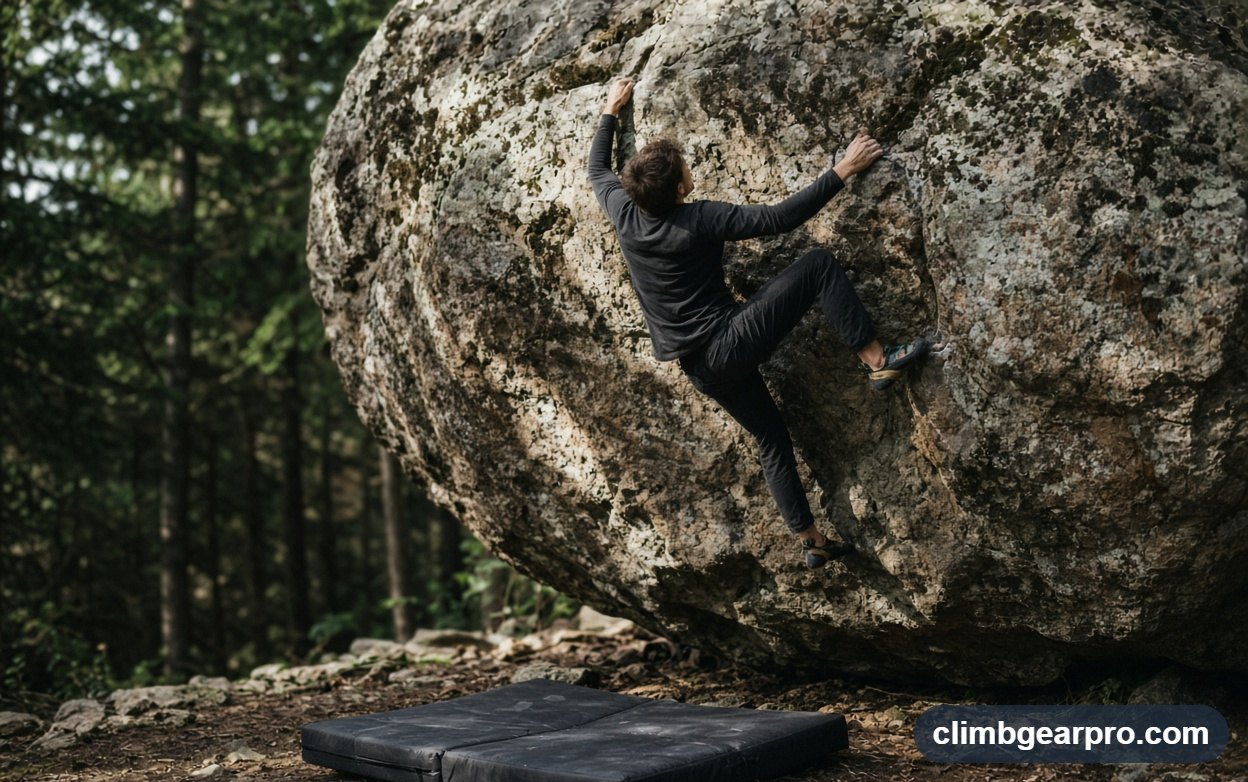
Even the best pad cannot fix a bad landing zone or a blind fall. Place the pad under your line, have a spotter guide your fall if you can, and walk the landing before you climb. For tall problems, bring a second pad and a friend.
How to Pick a Crash Pad in 5 Steps
- Look at the boulders you climb most and estimate the landing area you need.
- Decide how far you will hike with the pad on your back.
- Pick a size that covers the landing without being too heavy to carry.
- Compare hinge, closure and strap design, not just price.
- Plan a second pad if you climb tall problems or uneven ground.
Dos and Don’ts
Do
- Walk the landing and clear rocks and sticks
- Place the pad under your line before you climb
- Bring a spotter for tall or tricky problems
- Check the closure so there is no gap in the middle
Don’t
- Rely on a pad alone for highball falls
- Leave the pad in direct sun for days
- Climb above a pad that has compressed foam
- Skip a second pad on uneven ground
Honest Limits
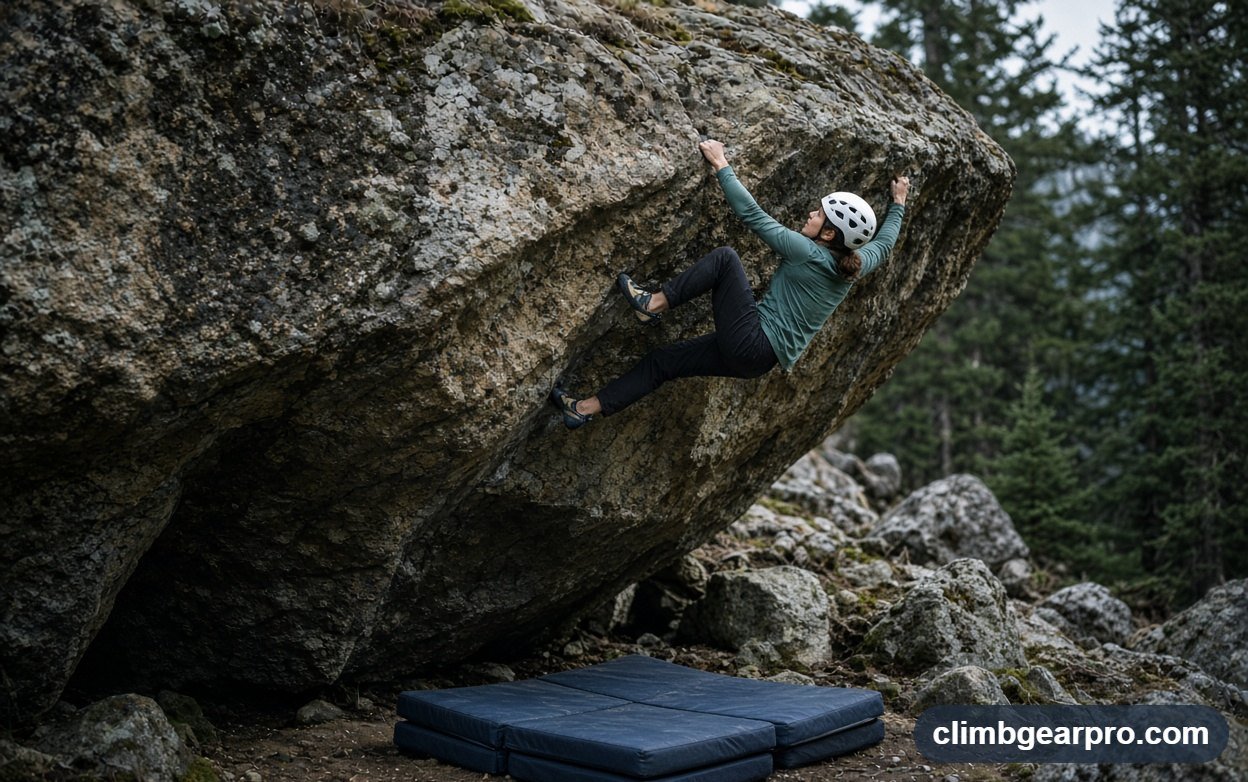
A crash pad does not make high falls safe. It spreads the load and reduces injury risk on a good landing, but ankle injuries, rolled landings and falls near the edge of the pad still happen. Bigger pads are not always better, since a heavy pad you do not carry protects nobody. Some budget brands have little long-term durability data, so buyer feedback is the best guide.
Frequently Asked Questions
What is the best budget bouldering crash pad?
The Asana Hero is a strong value pick for most climbers, while the Metolius Session II is the classic beginner choice. The Meister Boulder Beast XL is the cheapest large option here, with durability reports that vary.
How big should a crash pad be?
Most outdoor boulderers start with one mid-size pad. Taller problems and uneven landings call for a larger pad or a second pad.
Do I need two crash pads?
Not at first. Add a second pad when you climb tall problems, uneven landings or when you want gaps covered.
How long does a crash pad last?
It depends on use. Replace it when the foam stays compressed, the fabric tears or the closure fails.
Are cheap crash pads safe?
They can be if the size fits the landing and the build holds up. Check buyer feedback on foam, zippers and straps first.
The Bottom Line
The Asana Hero is the best budget bouldering crash pad for most climbers, and the Metolius Session II remains the safe beginner pick. If your boulders are tall, step up to the Magnum or the Petzl Cirro.
A pad is only one part of bouldering safety. Spot, scout the landing and be honest about your limits.